
Checking Criminal History in Gratiot County
Begin with the question the record must answer. MiCOURT is the best first stop for a filed Gratiot County criminal case. The county-linked JailTracker roster addresses present county custody. ICHAT shows the public part of Michigan criminal-history information that has reached the Michigan State Police Criminal Justice Information Center. An incident narrative, booking sheet, certified disposition, and statewide history are separate products. None replaces the others.
Collect a full legal name, date of birth when lawfully available, spelling variants, an approximate event date, and any case or report number. Then follow the event through the proper custodian. Similar names are common, and a blank screen can reflect the wrong court, protected material, an old file, or reporting delay.
- Search MiCOURT under both Gratiot court levels by name or case number.
- Check the 65B calendar for a near-term hearing and the jail roster for current custody.
- Ask the arresting agency for its incident report and the sheriff for booking material.
- Compare the court disposition with the ICHAT repository result.
- Request copies or certification from the office that holds the original record.
For a visual starting point, the official Gratiot County directory identifies the county offices involved.
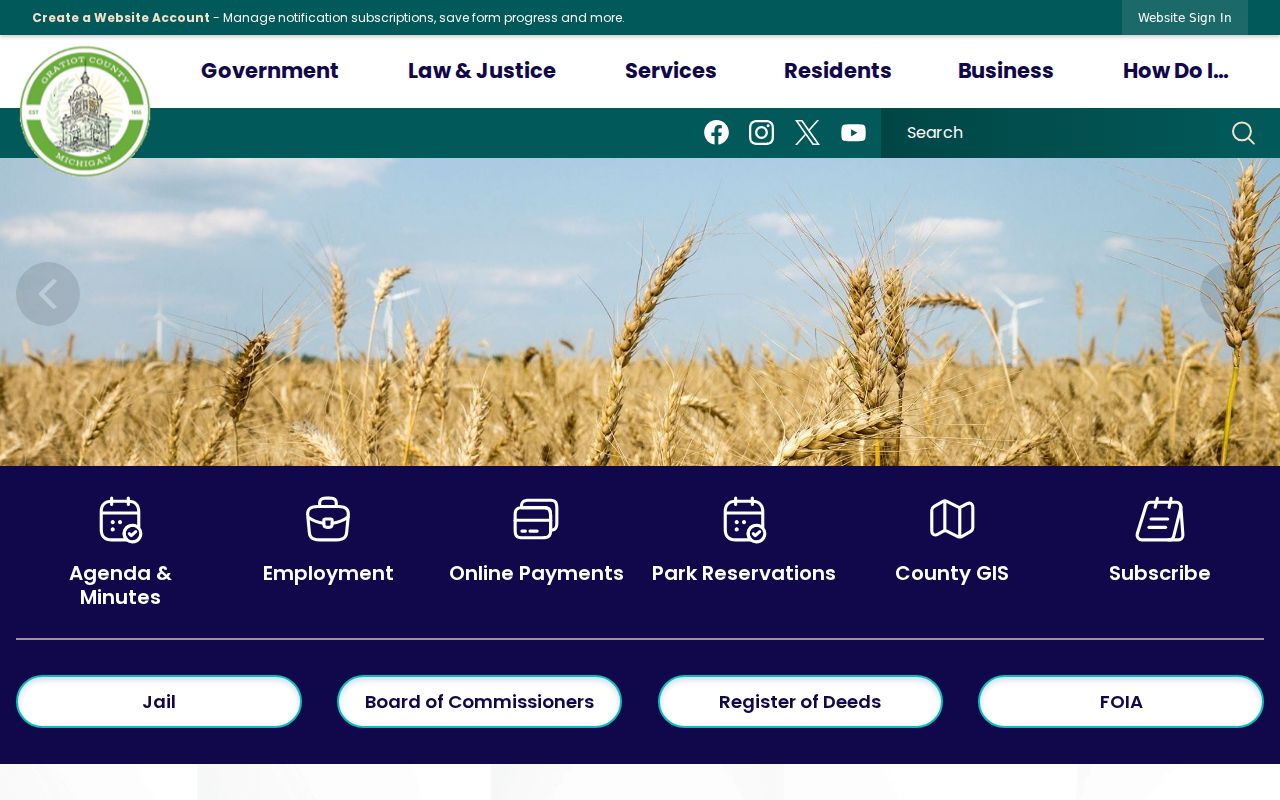
The directory helps a reader choose a custodian before sending a broad request to the wrong office.
One Block, Three Gratiot Records
Downtown Ithaca makes the records system look more unified than it is. The County Clerk and 29th Circuit Court work from the courthouse at 214 E. Center Street. The Sheriff and 70-bed County Jail are next door at 226 E. Center Street. The 65B District Court serves all 16 townships, the three cities, and the villages of Ashley, Breckenridge, and Perrinton. Each office creates and maintains a different part of a Gratiot County criminal record.
A misdemeanor stays in 65B through disposition. A felony begins there for arraignment and preliminary examination, then moves to the 29th Circuit after bindover. The sheriff answers jail and agency-report questions. Circuit Court Probation, at 114 S. Main Street, is another office when the sentence calls for felony supervision. Physical closeness does not merge these files.
65B District Court
Ithaca court complex
989-875-5240
Misdemeanors and felony preliminary stages
29th Circuit Court
214 E. Center St., Ithaca
989-875-5224
Felonies after bindover
Sheriff and Jail
226 E. Center St., Ithaca
989-875-5211
Custody, booking, and sheriff reports
The county’s Law and Justice gateway shows this local split in one official view.
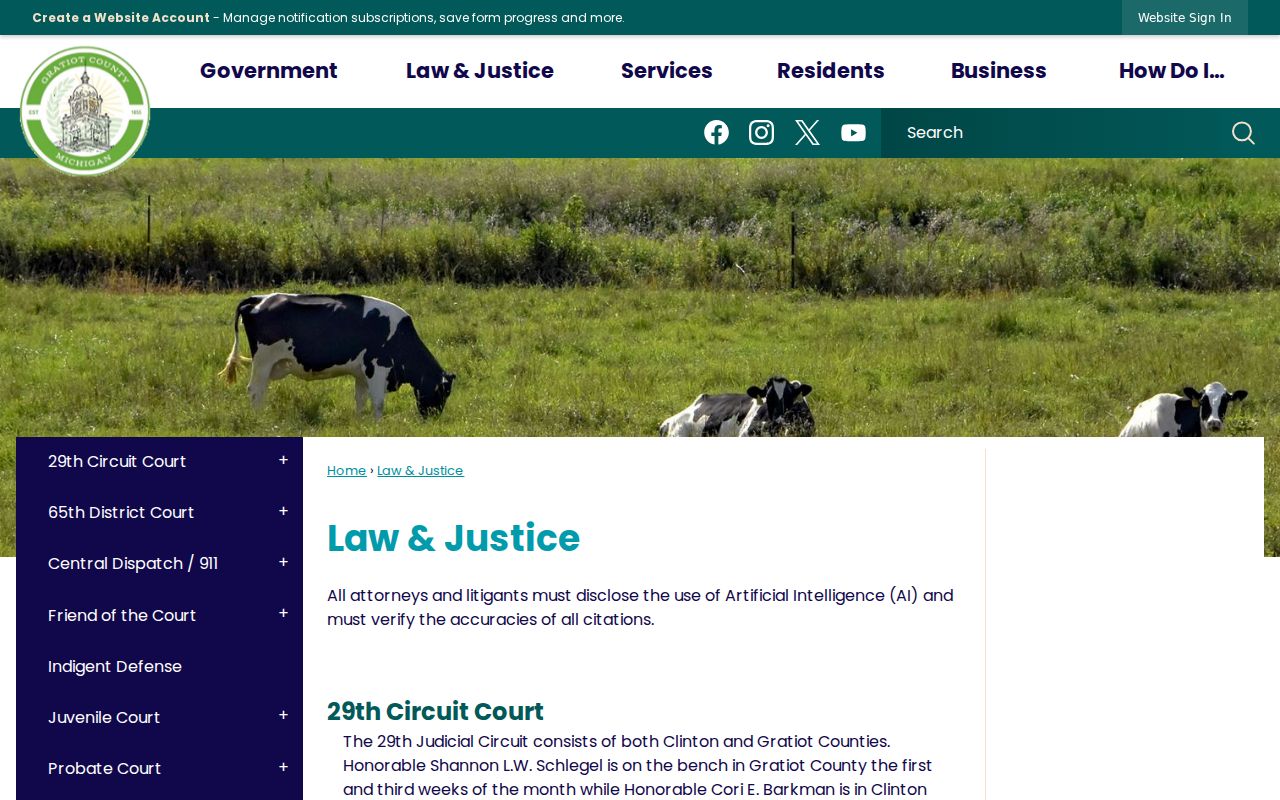
Its separate office links are a useful reminder to trace the kind of record, not just the person’s name.
Michigan Official Background Checks
The Michigan State Police operates ICHAT as the public name-based repository product. A search uses first name, last name, gender, and date of birth and costs $10. It can return reportable Michigan felony arrests and convictions plus serious-misdemeanor convictions. It does not include warrants, federal or tribal records, out-of-state events, juvenile records, traffic matters, suppressed records, or local misdemeanors.
Fingerprint comparison is the stronger identity method when a law authorizes it or when a person follows a state record-modification process. Michigan uses MSP-approved Live Scan vendors and local law-enforcement fingerprinting. A Michigan resident seeking a conviction set-aside can request an RI-008 applicant fingerprint card from local law enforcement. Call first because Gratiot’s posted fingerprint hours should not be assumed to cover every type of applicant print.
The MSP criminal-history overview explains the repository’s scope and exclusions.
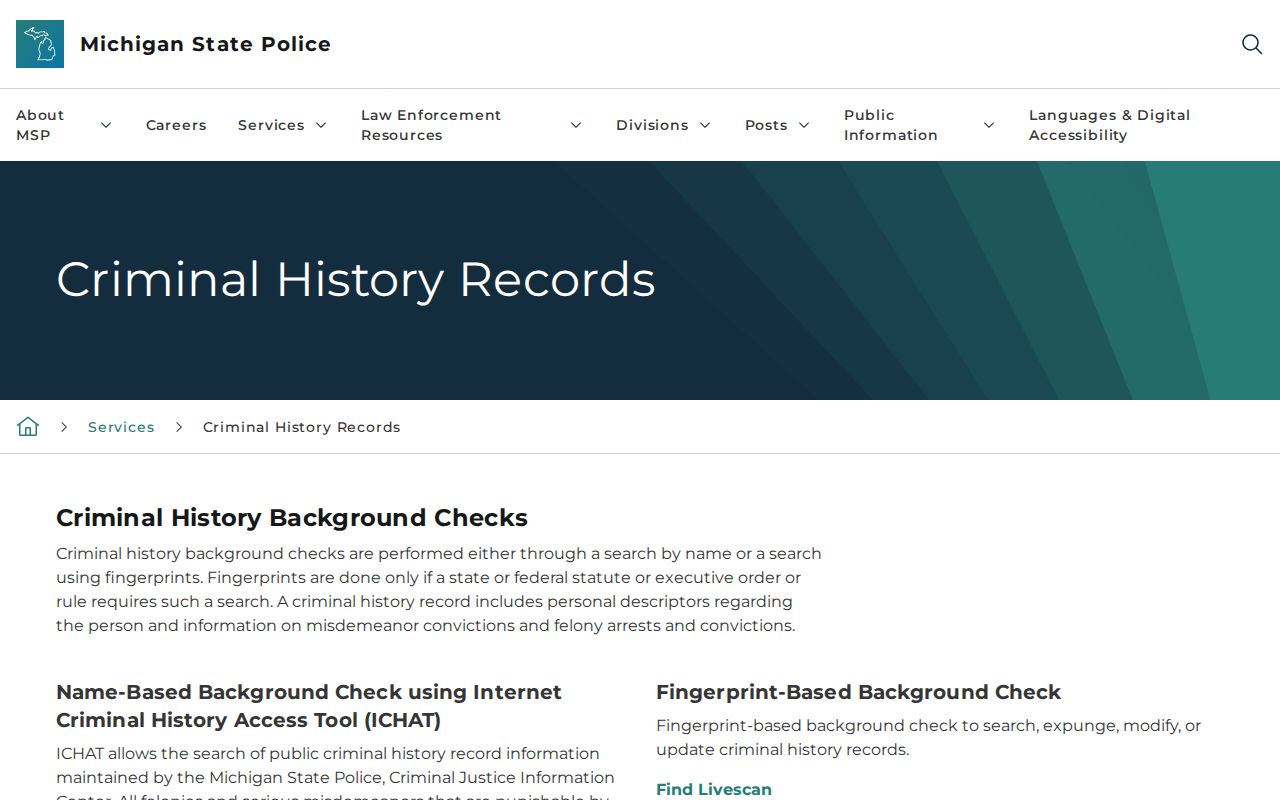
That state guidance should be read alongside the local case because repository reporting can lag or omit nonreportable events.
Gratiot ICHAT Criminal History Limits
ICHAT answers a narrow question: what public Michigan criminal-history information matches the submitted identity in CJIC. It does not answer whether someone is in the Gratiot County Jail today or whether a bench warrant is active. A searcher should compare a possible match with the court’s case number, charges, and final result. A name-based hit can belong to a different person with similar identifiers.
The official ICHAT access point leads into the state application.

The captured access screen does not justify guessing at live dropdown values, so only the fields confirmed by MSP are described here.
| Field | Need | Use |
|---|---|---|
| First name | Required | Identity search |
| Last name | Required | Identity search |
| Gender | Required | Name-match filter |
| Date of birth | Required | Reduces false matches |
Note: A clear ICHAT result is not proof that no Gratiot County police, jail, court, federal, or protected record exists.
Criminal Record Types
Criminal records describe different stages. Police create incident and arrest reports. The jail records a booking after accepting a person into custody. A prosecutor authorizes charges, while the court maintains the complaint, register of actions, orders, outcome, and sentence. CJIC assembles reportable fingerprint-supported arrest and disposition data. OTIS covers Michigan Department of Corrections custody and supervision, and PSOR publishes only the registry data Michigan law makes public.
- Police report: the event narrative and officer’s initial account.
- Booking record: jail intake, holding charge, bond, and release data.
- Court file: filed charges, hearings, pleas, rulings, and sentence.
- Repository history: the reportable state event cycle held by CJIC.
- Custody or registry record: present or recent status in a separate official system.
The Gratiot County criminal court cases page explains the district-to-circuit file in greater depth.
Gratiot County Custody Record Paths
Use the county-linked JailTracker roster for current jail listings, then call the jail’s 24-hour information line at 989-875-5211 when timing matters. Ask with the full legal name and date of birth if known. A booking-sheet copy comes from Sheriff Administration or the county FOIA route. No official source reviewed supplied current visitation, mail, or deposit details, so those points should be confirmed by phone rather than inferred from another county.
OTIS is the next channel for a person sentenced to MDOC custody, on state parole or probation, or recently discharged within the system’s stated window. It excludes county-jail-only custody and people who have never entered MDOC supervision. The official OTIS page provides that statewide record search.
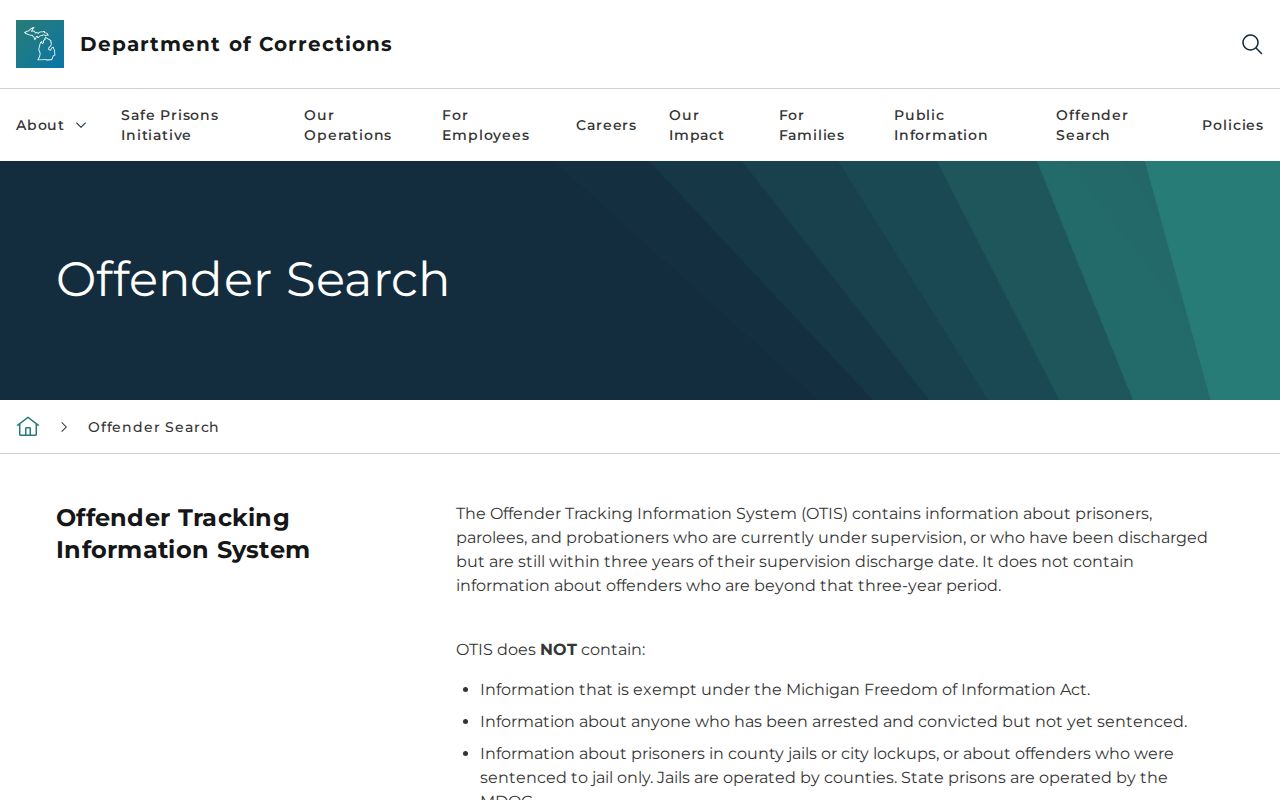
Moving from the county roster to OTIS follows custody status rather than assuming one database covers both local jail and state correctional records.
Inside a Gratiot County Criminal Record
A record should be read by source and date. Identity fields can include a legal name, aliases, date of birth, physical descriptors, and state or FBI identifiers. Event fields may show an arrest date, agency, charge, court number, prosecutor action, disposition, sentence, and supervision update. Public ICHAT data is narrower than the full law-enforcement history, while a local court file can show motions and orders that do not appear in the state product.
| Name and identifiers | Name, aliases, DOB, descriptors, and control numbers when public. |
|---|---|
| Arrest and booking | Agency, time, holding charge, booking number, bond, release, or transfer. |
| Filed charges | Complaint or information, counts, offense descriptions, and statute citations. |
| Disposition | Plea, verdict, dismissal, acquittal, or other result for each count. |
| Sentence | Custody, probation, financial assessments, and related court orders. |
| Supervision | County or MDOC custody, probation, parole, location, or discharge when public. |
“Closed” is only an administrative status. It does not state whether a charge ended in conviction or dismissal. Read each count and its disposition.
Gratiot Criminal Records by FOIA
A focused Michigan Freedom of Information Act request is the fallback for releasable county agency records that are not in a portal. Gratiot accepts requests by email at foia@gratiotmi.com and by mail or delivery to 214 E. Center Street, Ithaca, MI 48847. No special form is mandatory. The description should name the agency, approximate date and place, report number if known, and the exact parts sought, such as an incident report, booking sheet, CAD log, 911 audio, or available body-camera video.
The normal response period is five business days. The county may grant, deny, grant in part, or issue one written extension of up to ten business days. A response date is not a promise that production will occur that day. Retrieval, redaction, and a lawful fee estimate may follow. Active investigations, juvenile material, victim-sensitive facts, medical data, and security information may be withheld or redacted.
The Gratiot FOIA hub collects the county policy and request packet.
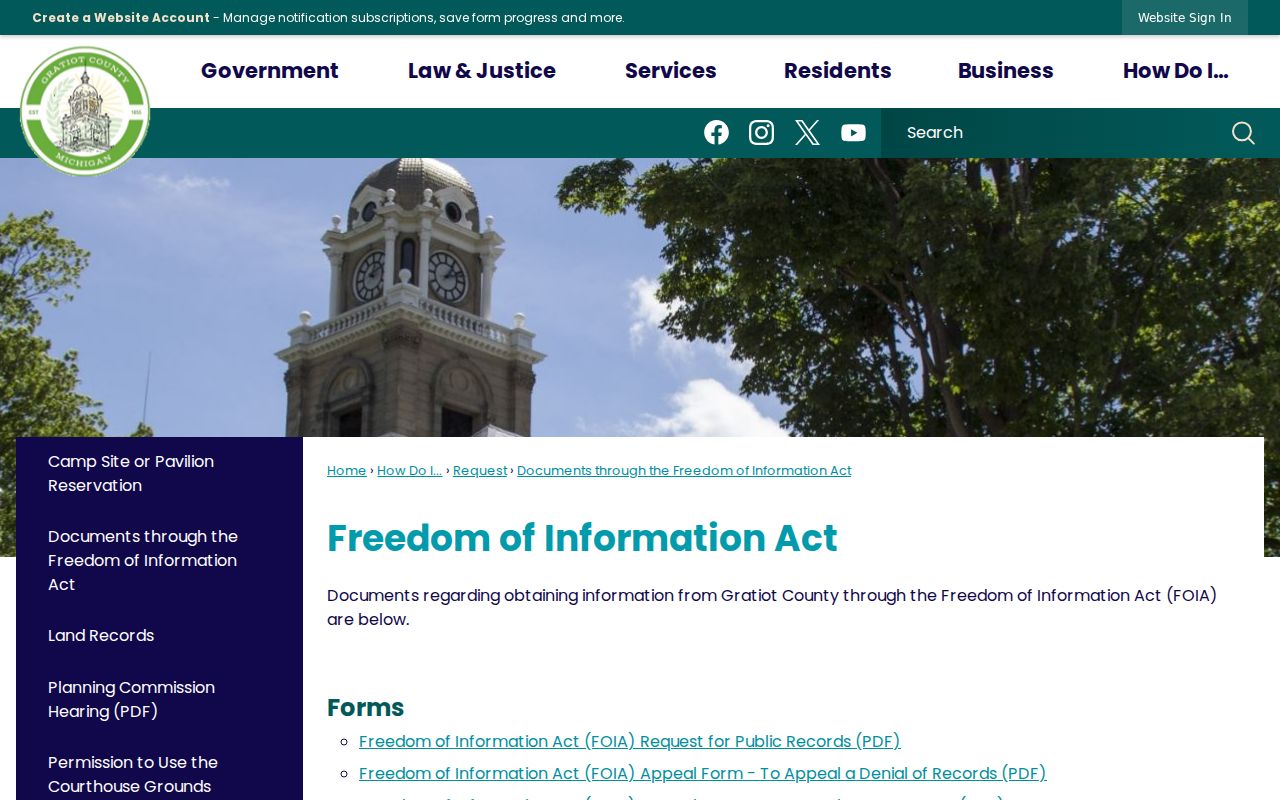
The hub also provides the appeal route when a request is denied or a fee is disputed.
| Service | Published amount |
|---|---|
| Sheriff in-house record check | $10 |
| Sheriff photocopies | $5 |
| Circuit name search, ten years | $12 per name |
| Set-aside CJIC processing | $50 |
| Sheriff fingerprint card | $15 per card, confirm first |
Public Access Laws in Michigan
Public access follows the custodian. Court records are governed by Michigan Court Rule 8.119 and clerk procedures. Police, jail administrative, and county records use Michigan FOIA. State criminal-history dissemination follows the CJIC statute and ICHAT rules. Public status does not remove redaction duties or make protected juvenile, victim, investigative, or set-aside information open.
Key Michigan rules:
MCL 15.231 states Michigan’s policy favoring access to nonexempt public records.
MCL 15.233 covers inspection, copying, and response timing.
MCL 15.243 lists exemptions, including protected privacy and investigative material.
MCL 28.242a governs public dissemination of Michigan criminal-history information.
When an office withholds material, the response should identify the legal ground. A requester can narrow the request or use the stated appeal route.
Gratiot County Warrant Record Fallback
Gratiot County does not publish a dedicated official active-warrant search, and ICHAT excludes warrants. Contact 65B District Court for misdemeanor, felony-preliminary, or failure-to-appear matters. Contact the 29th Circuit Court for a bound-over felony or postjudgment matter. The sheriff or jail line at 989-875-5211 can address custody and surrender routing, but the issuing court remains the key source for case status and bond instructions.
Have the full legal name, date of birth, case number if known, and issuing court ready. Do not send money based on an unsolicited call. A person resolving their own warrant should seek legal advice and arrange the proper appearance or surrender. Paying an online balance should not be assumed to clear a warrant.
- Arrest warrant
- A court order tied to a criminal complaint.
- Bench warrant
- A court warrant often issued after failure to appear or comply.
- Probation warrant
- A warrant tied to an alleged supervision violation, not a new conviction by itself.
Sealed, Expunged, and Restricted Records
Michigan’s main statutory term is “set aside,” though state materials also use “expungement.” A qualifying set-aside can remove a conviction from public ICHAT and court presentation while preserving limited access allowed by law. Juvenile matters, suppressed records, and victim or minor data can also be absent from public results. A no-result screen may therefore reflect a legal access rule rather than an event that never occurred.
An application-based Gratiot County set-aside starts with the complete court record and current state forms. The applicant checks eligibility, obtains the required fingerprint card, sends the state packet and $50 CJIC processing fee, serves the listed offices, attends any hearing, and later verifies the local and ICHAT presentation. MSP advises allowing about eight weeks for its search and mail response.
The MSP set-aside instructions describe the fingerprint and submission steps.
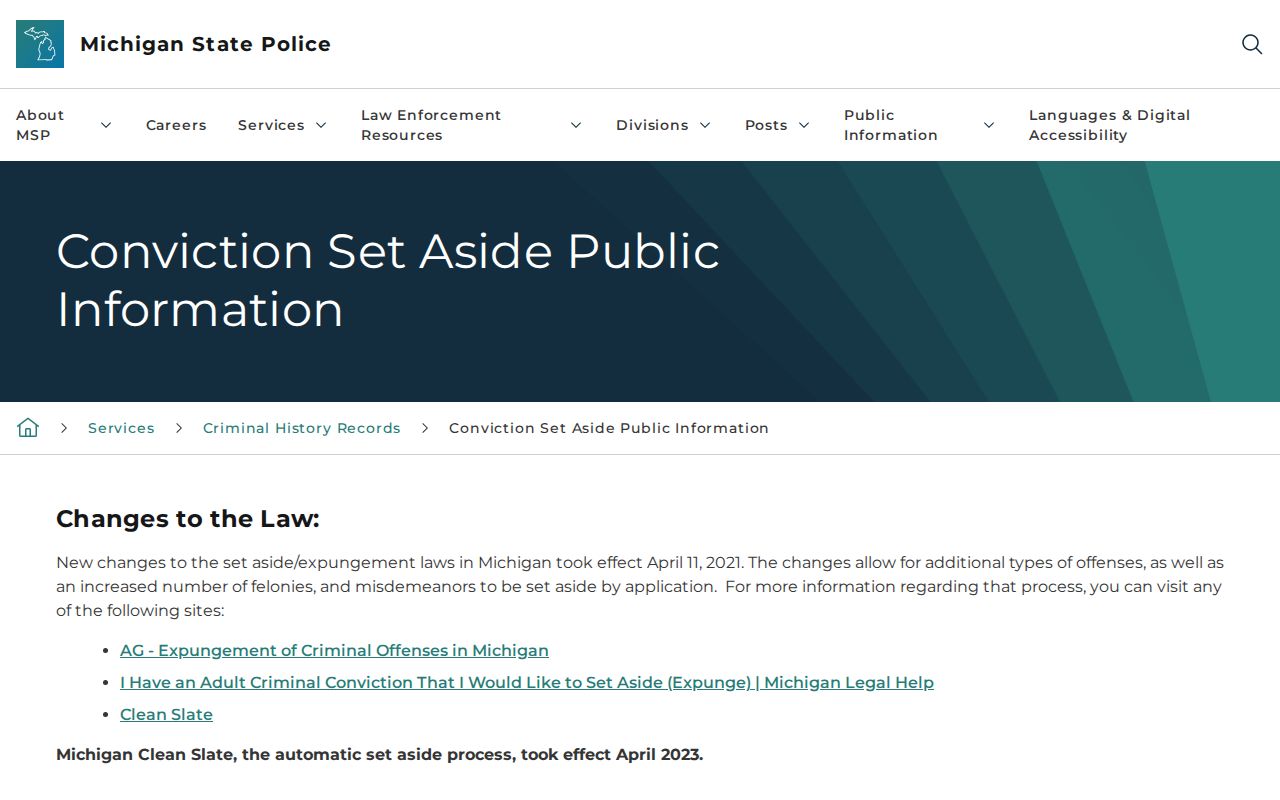
Those instructions should be paired with the current court forms because eligibility, waiting periods, and exclusions are fact-specific.
Gratiot Clean Slate Record Checks
Michigan also provides an automatic set-aside framework under Clean Slate. It has offense, count, and waiting-period limits, so it is not sound to promise that each old conviction will vanish. Application relief and automatic relief also do not erase every historical agency record for every authorized purpose. After relief, compare the signed order, the local court’s public presentation, and ICHAT. A mismatch may require the court to transmit corrected disposition data or an MSP correction request.
The Michigan judiciary’s set-aside forms collection is the official form source.

Use the current forms even when an older Gratiot County file uses different labels or dates.
Federal and Gratiot Criminal Records
Federal matters are outside MiCOURT and ICHAT. Gratiot County is in the U.S. District Court for the Western District of Michigan. PACER holds federal dockets and documents, subject to registration, fees, and sealed-record limits. An FBI Identity History Summary is different again: a person requests their own fingerprint-supported FBI record through the official electronic ordering process. It is not a public report about someone else.
The official PACER system is the authoritative federal docket channel.
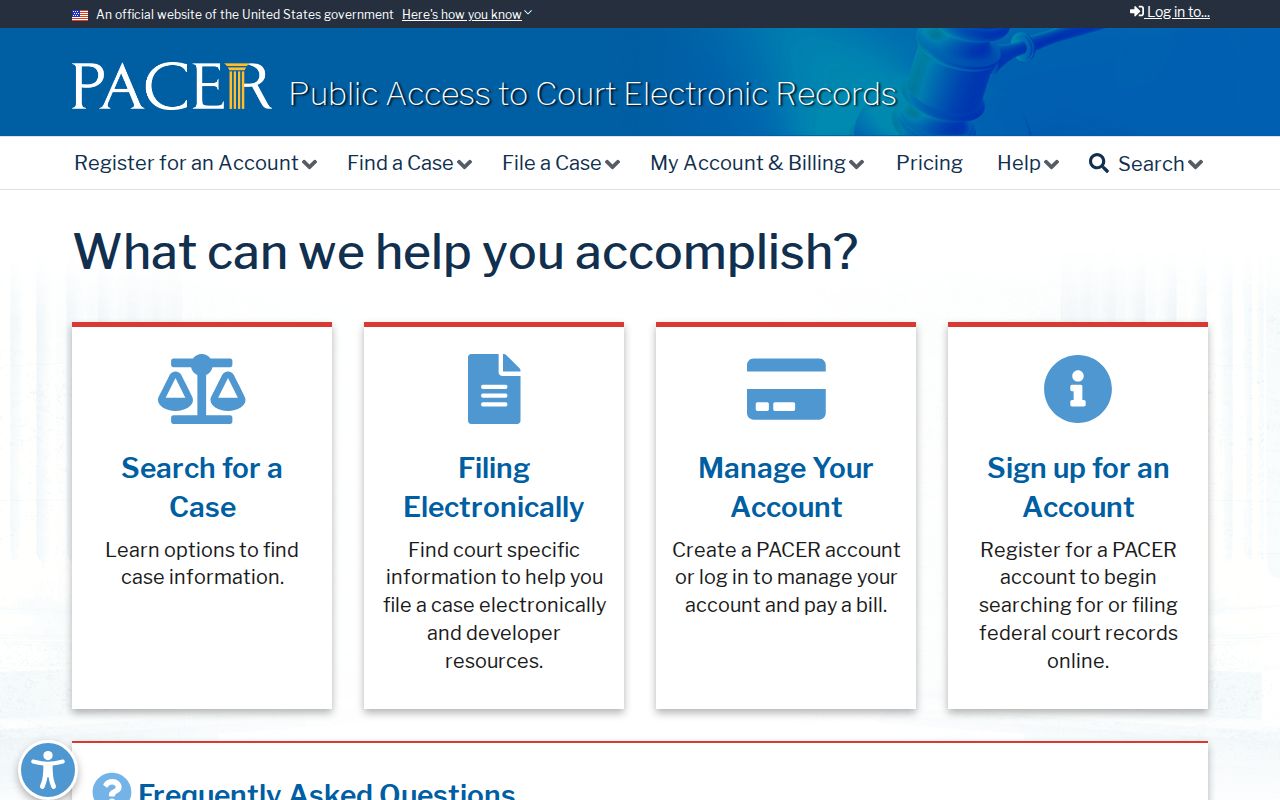
PACER’s federal case file should not be confused with a county case or state repository entry.
For personal federal review, the FBI Identity History Summary instructions describe fingerprint and identity submission.

The FBI product covers FBI-held identity-history information and does not replace a certified Gratiot court disposition.
Gratiot Specialty Court Records
The Mid-Michigan Regional Mental Health Court and Mid-Michigan Regional Sobriety Court add local supervision and progress events to some 65B records. A docket entry may reflect a review, condition, sanction, or program step rather than a new conviction. The Office of Community Corrections works under 65B guidance and serves courts across the 29th Circuit. This regional structure is one reason to read the register of actions in sequence.
The 29th Judicial Circuit also spans Clinton and Gratiot Counties. The same circuit judges may serve both, so “29th Circuit” alone does not confirm the county. Select Gratiot in MiCOURT and confirm the hearing place from the notice or assignment clerk.
Gratiot County Criminal Records by City
Alma, St. Louis, and Ithaca are Gratiot County’s three largest incorporated cities. A city police report stays with the agency that created it, while booking and court records move into county systems. Ithaca’s police-service transition makes the incident date and responding agency especially important. Each city page follows its own request channel without treating the county court as a city court.
Alma Criminal Records
Largest city; Alma Police reports pair with county jail and court records.
St. Louis Criminal Records
City FOIA supplies police records while 65B and 29th Circuit hold cases.
Ithaca Criminal Records
County seat; report routing depends on the responder and incident date.