
Checking Criminal History in St. Louis
St. Louis records must be checked by custodian, not through one citywide database. The local police file explains the call and officer action. The Gratiot County booking record documents admission to jail. The 65B and 29th Circuit dockets show what prosecutors filed and how the case ended. State systems answer later questions about reportable criminal history or MDOC custody.
Begin with facts that can separate similar names, such as date of birth, event date, location, incident number, or case number. Then use this sequence:
- Check the St. Louis Police Department source and identify whether it created the incident report.
- Submit a focused written request through the city FOIA process for the police record.
- Search 65B District Court in MiCOURT for the first filed criminal case.
- Check the Gratiot jail channel for booking or custody, and search the circuit court after a felony bindover.
- Use ICHAT for reportable Michigan history or OTIS only when MDOC custody or supervision is the actual question.
St. Louis Police FOIA Starts
The city’s FOIA administration page is the formal entry point for an existing St. Louis police report. It provides the city form, procedures, and public summary. A request should identify the police incident, date and approximate time, location, and report number when known. That level of detail lets the city locate the right record without creating a new summary.
The city may grant, deny, or partly grant a request, and it may redact information protected by Michigan law. Active investigative facts, juvenile material, victim-sensitive details, private data, and other exempt information can be withheld. A written description is still useful when a request is narrow because it preserves what was asked for and supports a later fee or denial appeal.
Michigan’s normal FOIA response period is five business days. A public body may also issue one written extension of up to ten business days. That deadline concerns the response, not a promise that every St. Louis record will be produced by the fifth day. Search work, lawful redaction, a fee estimate, or a permitted deposit can affect delivery. A response should say whether the request is granted, denied, granted in part, or extended. If the city cannot identify the record, a requester can narrow the date range or add the police report number instead of sending a second broad request.
The official FOIA page shows the current local process.
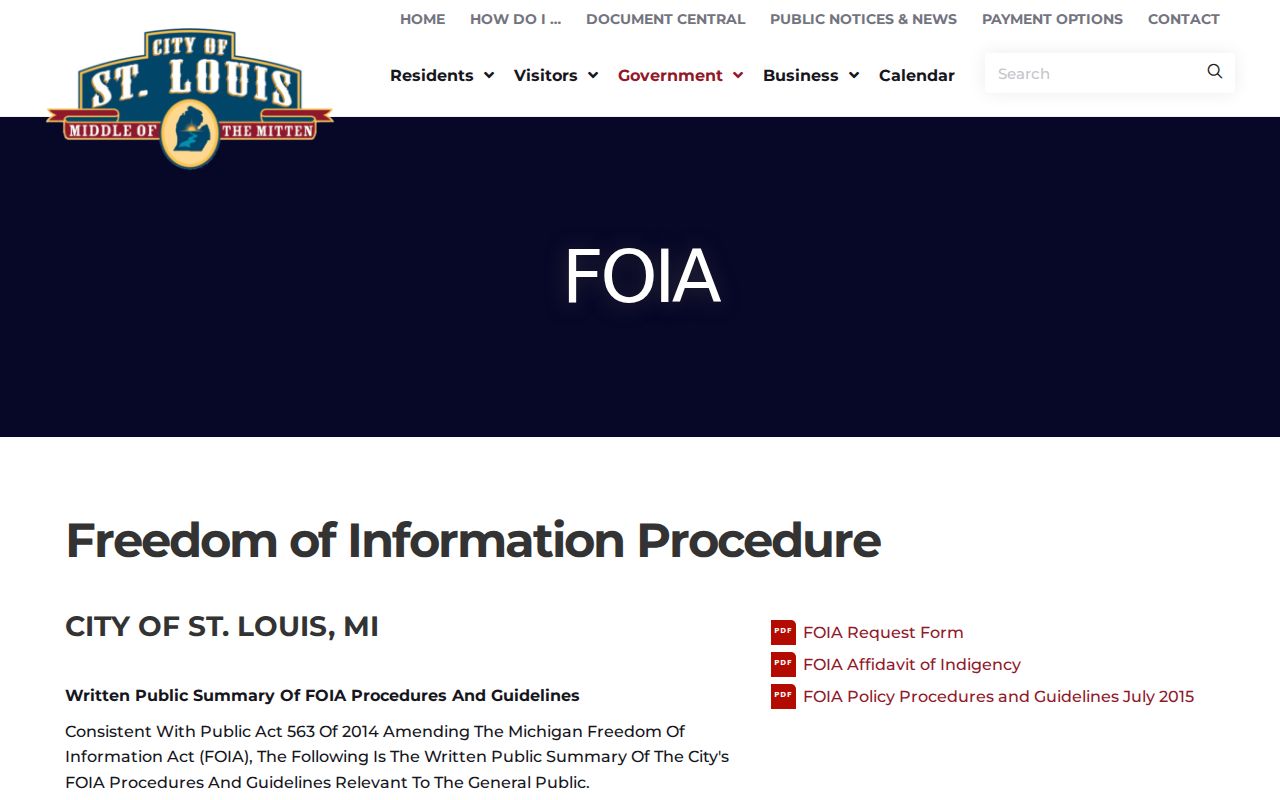
That city source should be used for the St. Louis narrative rather than the Gratiot County request form.
St. Louis Police Department Records
The St. Louis Police Department page combines local department information with links to Michigan record systems. The local department remains the custodian of its own incident and arrest reports. A state link on the police page does not move that city record to Lansing and does not turn a state database into a St. Louis arrest log.
A police record can include the incident number, call date and time, location, officer narrative, alleged offense, evidence or property references, and arrest action. Some details may be redacted. If the request instead seeks a booking sheet, use the Gratiot County Sheriff and jail channel. If it seeks the filed complaint, disposition, or sentence, use the court clerk.
The city police source illustrates this mix of local and state routing.
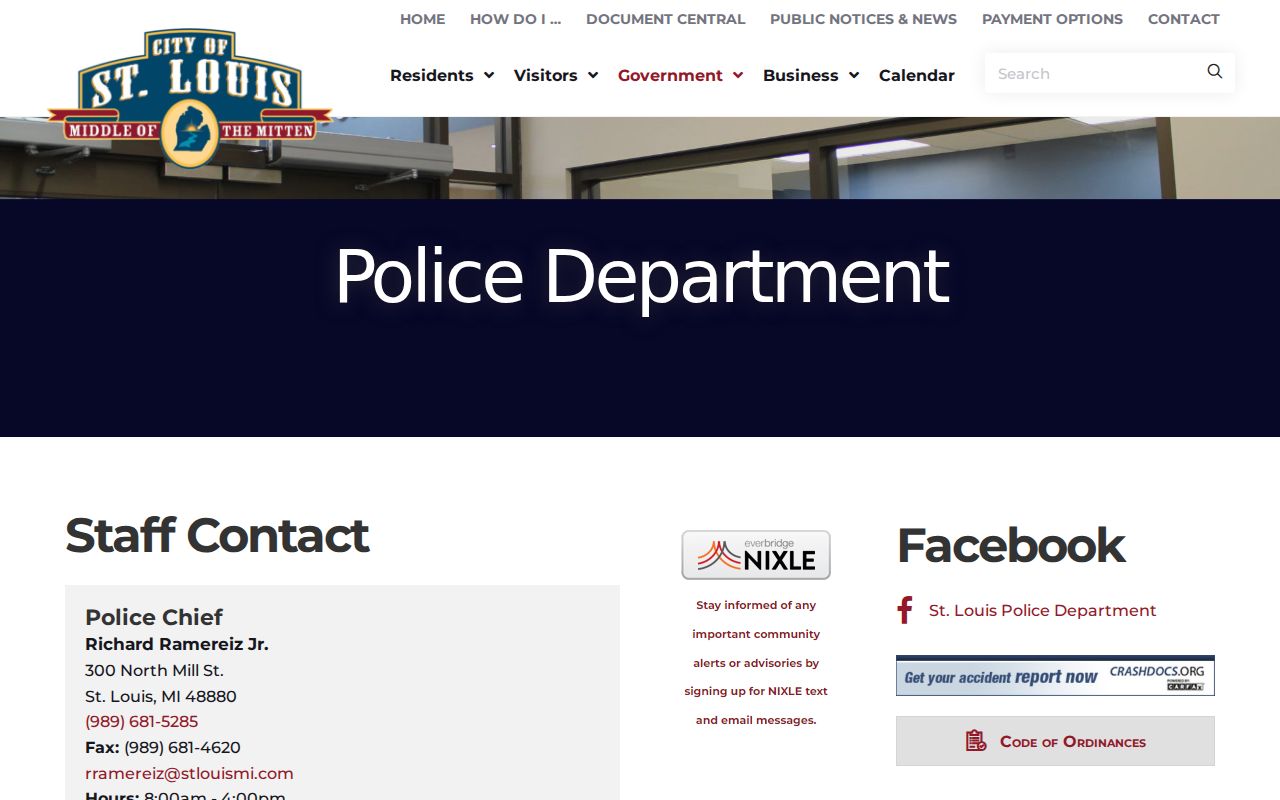
Reading each linked product by its stated scope keeps a St. Louis report from being confused with a statewide custody record.
OTIS Is Not St. Louis Arrest Search
OTIS appears among the useful Michigan links on the St. Louis police source, but it answers a different question. The Michigan Department of Corrections system covers people under state prison, parole, or qualifying probation supervision and certain people recently discharged. It excludes county-jail-only custody and people who were never under MDOC authority.
Use OTIS when a court sentence points to MDOC or when a person may have left Gratiot County Jail for state custody. For a recent St. Louis arrest, start with the local police record, the county roster and jail line, and 65B court. An empty OTIS search is not proof that no city arrest happened. It may simply mean the event never entered the state corrections system.
St. Louis Arrests and Bookings
St. Louis arrestees are booked through Gratiot County Jail rather than a standalone city custody database. The move from St. Louis to Ithaca creates two distinct records. St. Louis Police keeps the report explaining what its officer did. The jail records booking time, holding charge, bond, custody status, and release or transfer information that is public.
Use the county-linked JailTracker roster for current listings, then call the jail at 989-875-5211 when time matters. Ask the Sheriff’s Office for a booking-sheet copy through its records or county FOIA channel. The jail record documents custody, not guilt. Prosecutor review may change the first holding charge, and only the court file establishes the final filed charge and outcome.
Note: St. Louis has no official city arrest gallery, so use the police, jail, and court sources for distinct facts.
St. Louis Records Cross the County
St. Louis is known locally as the “Middle of the Mitten,” yet its criminal record system is not centered in one city office. The police narrative begins in St. Louis. Booking and trial-court functions sit in Ithaca. A state repository record can later be held by the Michigan State Police Criminal Justice Information Center. Physical distance does not merge those records.
This city-to-county route is important when someone has only part of the file. A St. Louis incident number helps the police locate its report but may not match the court case number. A booking number belongs to the jail. A MiCOURT case number belongs to the clerk. Keep each number with its source and date, then compare the names, charges, and outcome rather than expecting one number to work everywhere.
Municipal Court Records in St. Louis
St. Louis does not offer a separate municipal criminal court portal. Criminal matters and applicable ordinance cases use Gratiot’s 65B District Court. The district court handles misdemeanors through disposition and conducts arraignment and preliminary proceedings in felony cases. A bound-over felony continues in the 29th Circuit Court.
The court record inventory helps distinguish the local police file from the judicial file:
| Court Name | 65B District Court; 29th Circuit Court for bound-over felonies |
|---|---|
| Case Types Heard | Misdemeanors and felony preliminary stages in district; felony trial and sentence in circuit |
| Case Lookup Channel | MiCOURT, 65B live docket, public terminal, or clerk contact |
| What the Docket Shows | Filed counts, hearings, register events, status, disposition, sentence, and financial entries where public |
| Copies & Fees | Request pleadings or certified dispositions from the proper clerk; exact current criminal-copy fees were not found |
Missing St. Louis Court Records
A “no results” message in MiCOURT does not settle whether a St. Louis case ever existed. The wrong court may be selected. A name may be spelled differently. The case may be too new, older and not migrated, nonpublic, or protected. A felony may also appear first in 65B and later under a circuit case number after bindover.
Search the official MiCOURT system by case number when available. For a name search, add the first and middle name and date of birth where the interface permits. Check both Gratiot court levels, then call 65B at 989-875-5240 or the circuit clerk at 989-875-5224. Staff can explain record access and provide copies, though they cannot choose a legal remedy.
A St. Louis felony can also appear under two related dockets as it moves. The district file records arraignment, bond, the probable-cause conference, and preliminary examination or waiver. A bindover then sends the felony to circuit court for an information, further arraignment, motions, plea or trial, disposition, and sentence. “Bound over” is not a conviction. It is the point at which the St. Louis case changes court levels, so it is a clue to search again rather than a final outcome.
Where St. Louis Records Go
Police records feed a longer justice chain without losing their separate custodians. The prosecutor reviews the St. Louis police submission and decides what charge to authorize. The court records arraignment, events, pleas, orders, disposition, and sentence. Reportable fingerprints and matched dispositions can then reach Michigan’s central repository.
Record flow: St. Louis Police Department › Gratiot County Courts › Michigan State Police Criminal Justice Information Center
ICHAT is the public repository product. It can show reportable Michigan felony arrests and convictions and serious-misdemeanor convictions, but it omits warrants, local misdemeanors, juvenile matters, traffic records, federal or out-of-state cases, and suppressed information. Compare any St. Louis name match with the live local docket before drawing a conclusion.
St. Louis Crash Record Channels
Traffic Crash Purchasing System records and St. Louis police reports may concern the same event, but the products are not interchangeable. TCPS is the Michigan channel for eligible crash reports. The city process is the route for a St. Louis Police incident narrative or another releasable city-held attachment. Start by naming the crash date, place, driver details, and report number.
If the state crash search succeeds but the desired narrative is absent, submit a city FOIA request for the specific existing record. If the event led to a criminal charge, search 65B separately. A crash form does not establish that a criminal case was filed, and a district docket will not supply the full officer narrative. Each St. Louis source should be used for the record it actually keeps.
Public Access Rules in St. Louis
St. Louis police and administrative records are governed by the Michigan Freedom of Information Act. Court files use Michigan Court Rule 8.119 rather than city FOIA. Michigan criminal-history dissemination law controls the public repository view. Choosing the correct rule is part of choosing the correct custodian.
The St. Louis FOIA materials also note a statutory requester limitation: a person serving a sentence of imprisonment in a local, state, or federal correctional facility is not entitled to submit a Michigan FOIA request. That rule should not be expanded beyond the city’s stated notice or confused with access to the person's own court proceeding through counsel and court procedures.
Key Statutes:
MCL 15.231 sets Michigan's public-access policy for nonexempt government records.
MCL 15.233 governs inspection, copying, requests, and agency response timing.
MCL 28.242a controls public dissemination of Michigan criminal-history information.
St. Louis City Records Context
The official St. Louis homepage provides the city setting and routes readers to government departments.

The city source is useful for finding the current police and administration pages, while the county court and jail remain separate destinations.
When a St. Louis record is incomplete, ask which stage is missing. For the officer account, return to the city. For booking and release, use the jail. For filed charges and outcome, use the courts. For later state custody, use OTIS. For public reportable Michigan history, use ICHAT. That question-based approach is more reliable than repeating the same name in unrelated databases.
Note: Confirm a record with its originating St. Louis or Gratiot office before relying on a similar-name search result.